


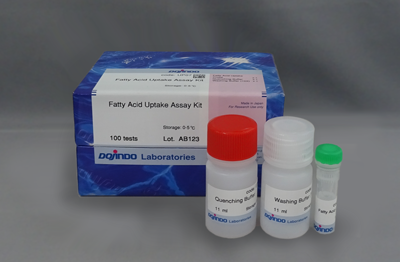
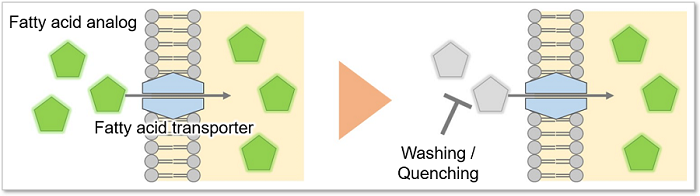
This kit uses Fatty Acid Uptake Probe as a fatty acid analog, which can be uptaken into cells via fatty acid transporters on the cell membrane surface. Cellular fatty acids uptake ability can be evaluated by the fluorescence intensity with fluorescence microscopies, flow cytometers, plate readers or other fluorescence instruments. In addition, a reagent that eliminates the fluorescence of any extracellular fatty acid analog is included, so it is possible to easily measure the actual fatty acid uptake capability even if washing the cells is difficult.

Technical info
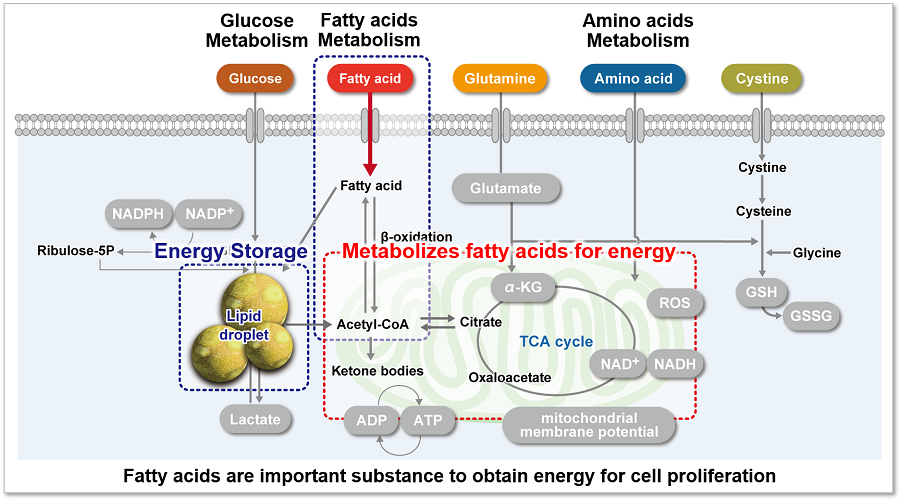
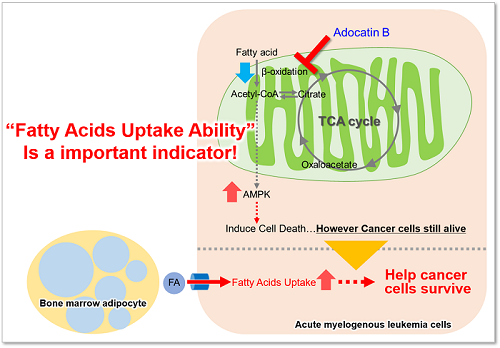
Fatty acids are important for the body to obtain energy. Fatty acid uptake ability is not only related to diseases such as obesity and diabetes but is also one of the metabolic indicators in cancer cells (upper figure). Cancer cells, which are proliferating rapidly, require large amounts of lipids, and therefore, intracellular fatty acid synthesis and uptake of fatty acids from the medium are actively taking place (lower figure). Therefore, many cancer therapies have been developed to target the fatty acid metabolic pathway in cancer cells.
This kit solves it all! Technique Issues in Fatty Acid Uptake Experiments
This kit addresses all of the following comments and problems from fatty acid uptake researchers.
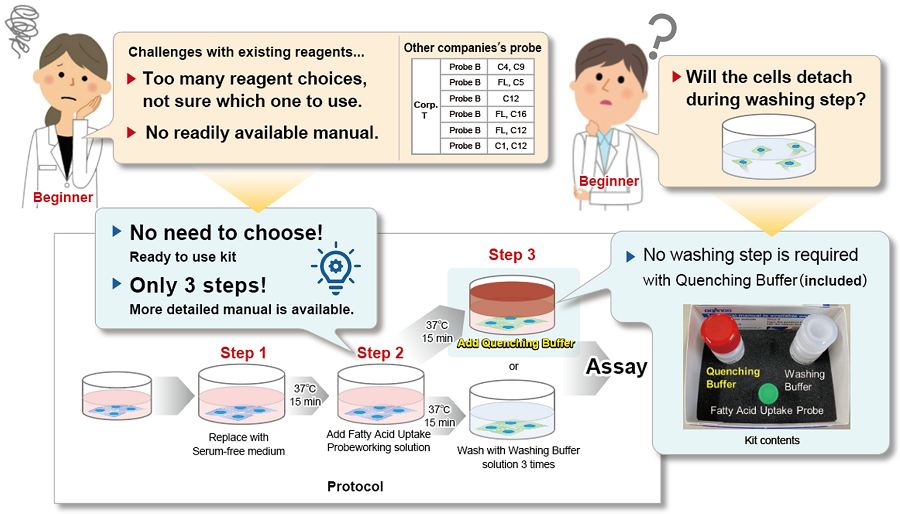
This kit contains a fatty acid analog (Fatty Acid Uptake Probe) which can be uptaken by cells via fatty acid transporters, and fatty acid uptake ability can be detected by a fluorescence method (Principle). The Quenching Buffer enables detection without cell-washing steps (Protocol).
Principle
Protocol

How to choose between Washing Buffer and Quenching Buffer?
Please refer to the table below and select either Washing Buffer or Quenching Buffer according to the cell type and instruments.
| Washing Buffer (10×) | Quenching Buffer | ||||
|---|---|---|---|---|---|
| Adherent cell | Floating cell | Adherent cell | Floating cell | ||
| Cell-washing Procedure | Necessary | Unnecessary | |||
| Plate Reader | Bottom Reading (Clear Bottom) | Applicable | Applicable | Conditionally*1 | |
| Top Reading | Applicable | Inapplicable | |||
| Fluorescene Microscope | Applicable | Applicable | |||
| Confocal Microscope | Applicable | Conditionally*2 | |||
| Flow Cytometer | Applicable | Inapplicable | |||
*1 The cell number needs to be sufficient to cover the bottom of the well(Approx. 3×10⁵ cells/well), after the cells settled on the bottom of the well, it is possible to assay.
*2When using a confocal microscope, transmitted light mode with 488 nm is not possible. When performing transmitted light observation, please dilute the Quenching Buffer 10-fold with Washing Buffer or using a 640 nm laser.
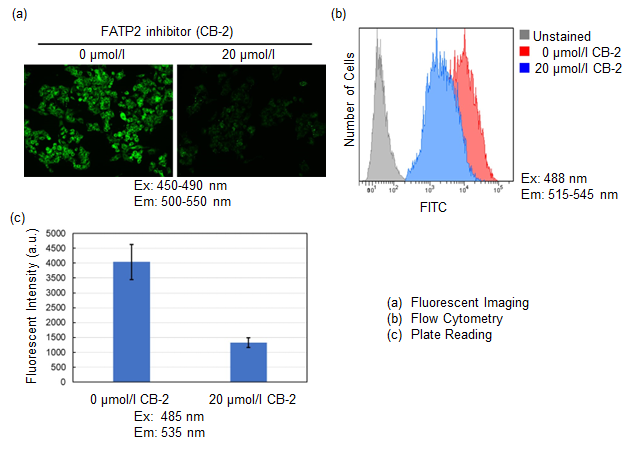
Inhibition of fatty acid uptake by fatty acid uptake inhibitor:CB-2
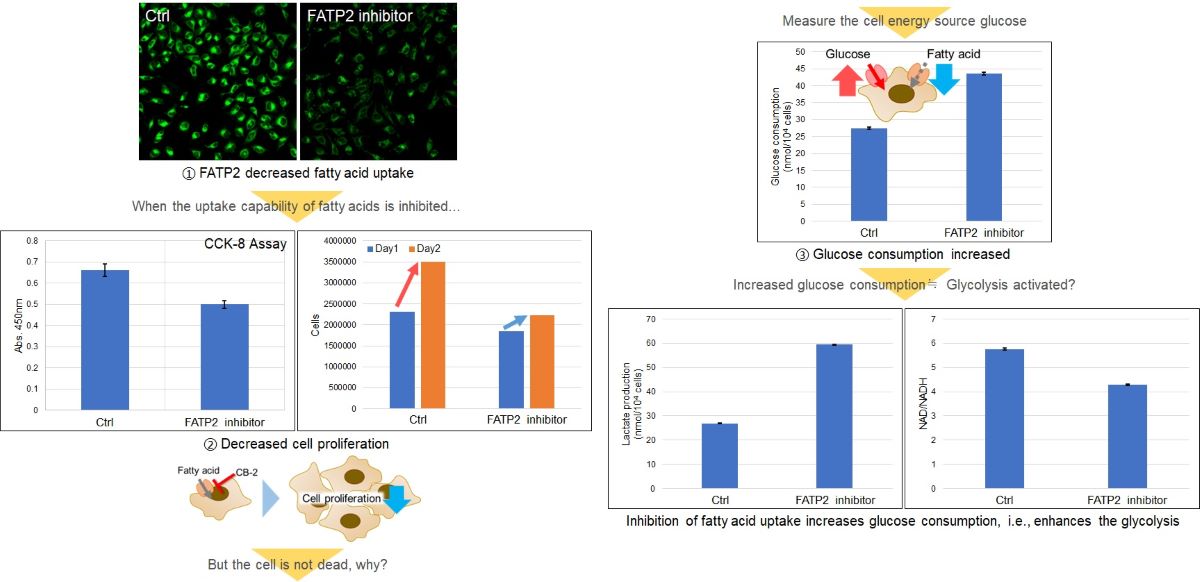
Using this kit, we were able to observe and quantify the inhibition of fatty acid uptake in HepG2 cells by a fatty acid transporter inhibitor (FATP2 inhibitor: CB-2). Please refer to the instruction manual for details of the experimental procedure.
Application Data: Evaluation of Fatty Acid Metabolism
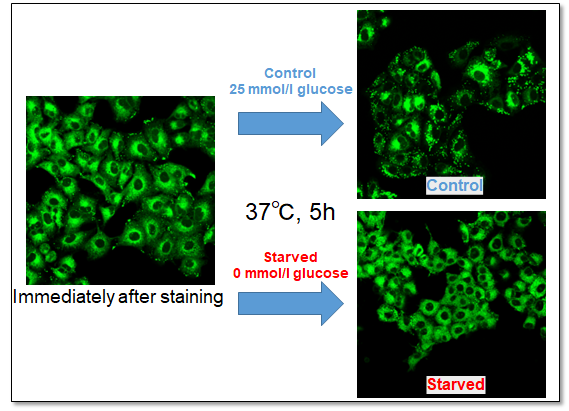
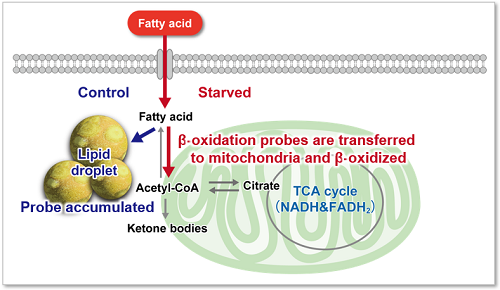
Immediately after staining, the probe was localized throughout the cytoplasm. While it was localized mainly in lipid droples when the cells were incubated in medium containing 25 mmol/l glucose (Control). On the other hand, glucose starvation treatment (Starved) showed the probe localization in mitochondria and endoplasmic reticulum, suggesting enhanced β-oxidation. The product was confirmed to be able to detect changes in fatty acid metabolism after uptake.
<Observation Condition>
Filter set: GFP (Ex = 450 – 490 nm, Em = 500 – 550 nm)
Application Data: Alteration of intracellular metabolism of HeLa cells by treatment with fatty acid transporter inhibitors
Fatty acids are important for membrane synthesis and are essential for cell proliferation. HeLa cells were treated with a fatty acid transporter inhibitor, and then the cell proliferation and intracellular metabolism (glucose consumption, Lactate release, and NAD/NADH ratio) were tested.
The results showed a decrease in cell proliferation, an increase in glucose consumption and Lactate release, and a decrease in the intracellular NAD+/NADH ratio, indicating a shift in the metabolic pathway to glycolysis.
<Related Products>
Cell Proliferation: Cell Counting Kit-8 (Code: CK04)
Glucose: Glucose Assay Kit-WST (Code: G264)
Lactate: Lactate Assay Kit-WST (Code: L256)
NAD/NADH Ratio: NAD/NADH Assay Kit-WST (Code: N509)