


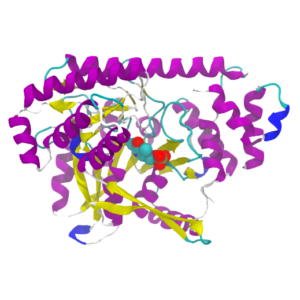
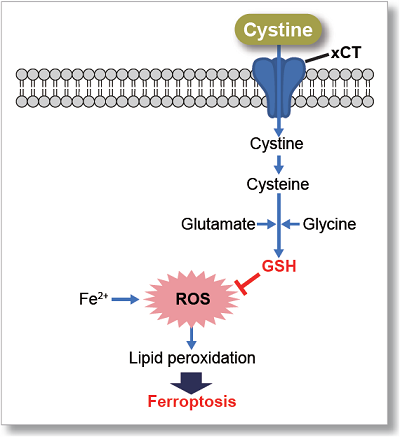
The cystine transporter xCT is a crucial transporter that maintains cellular redox balance by regulating glutathione synthesis via cystine uptake. xCT is highly expressed in several types of cancer cells and is expected to be a therapeutic target for cancer.
Therefore, xCT has recently attracted researchers’ attention as one of the targets for cancer treatment. The xCT inhibitors sulfasalazine and erastin are known to reduce intracellular glutathione levels by inhibiting cystine uptake, thereby inducing ferroptosis, a form of cell death. It is also known that immune cells highly express xCT upon activation, suggesting that intracellular redox regulation via cystine uptake is also important for immune responses.


Technical info
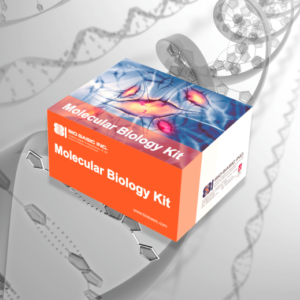
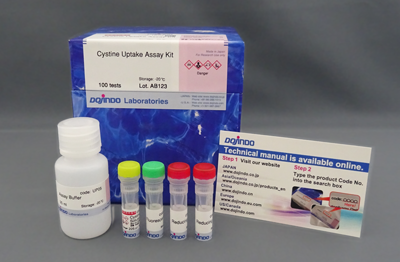
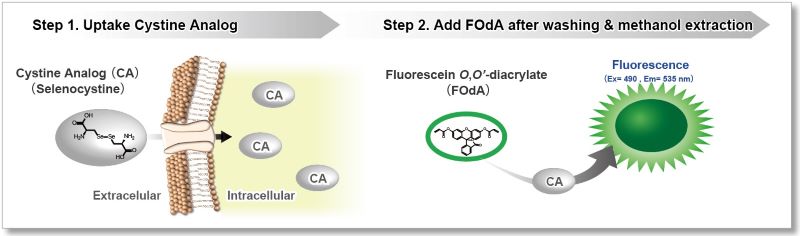
This kit uses Selenocystine as a Cystine Analog (CA) and can measure the cystine uptake ability of cells by a plate reader in a short time.
Principle
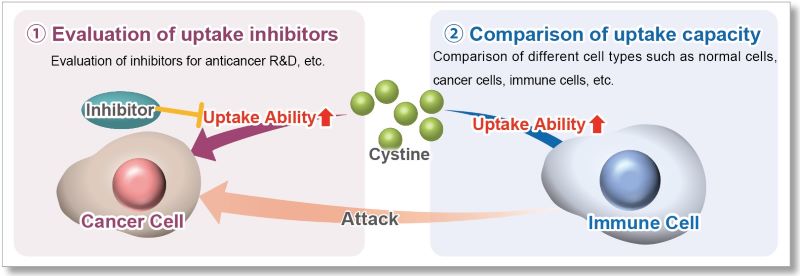
The Cystine Analog (CA) in this kit can be taken up into cells via xCT, and the incorporated CA can be specifically detected using the Fluorescent Probe and Reducing Agent. Thus, the xCT activity can be measured easily.[Patent applied]
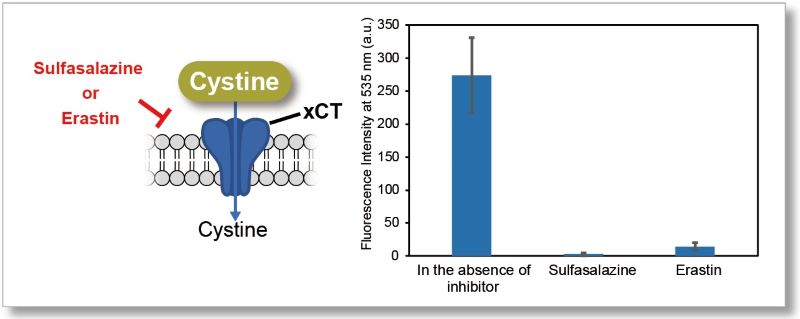
Application Data 1: Evaluation of xCT inhibitor Sulfasalazine or Erastin)
Using this kit, we measured the inhibitory effect of sulfasalazine and erastin on cystine uptake by HeLa cells.
The fluorescence intensity of the sulfasalazine and elastin groups decreased significantly, indicating that both reagents inhibit cystine uptake.

Experiment Condiitons
Cell Line: HeLa cells
Pretreatment: DMEM (cystine-free, serum-free), 37℃, 5 min
Uptake conditions:0.5 mmol/l sulfasalazine or 2 μmol/l erastin / Cystine Analog / DMEM (cystine-free, serum-free), 37℃, 30 min
Instrument: Fluorescent Plate Reader
Filter: Ex=485 nm, Em=535 nm
Application Data 2: Comparison with Radio Isotope Method
Cystine uptake assay, which used to require RI measurement, can now be easily measured with a plate reader. We compared the uptake in Wild-type (WT), xCT-knockout (KO), and xCT-overexpressed (OE) cells, using Cystine Uptake Assay Kit and Radio Isotope method using [14C]-labeled cystine. As a result, in both cases, the uptake was decreased in KO and increased in OE compared to WT. Therefore, it was confirmed that this product correlated well with the Radio Isotope method.
*This data was kindly provided by Professor Hideyo Sato and Assistant Professor Mami Sato, Laboratory of Biochemistry and Molecular Biology, Department of Medical Technology, Faculty of Medicine, Niigata University.
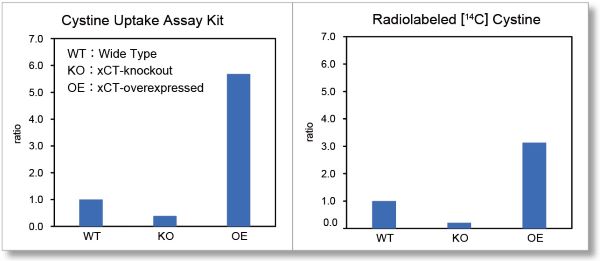
(Using WT’s result as a benchmark value)
Experimental Conditions
Cell Line: HT1080 cells (wild-type or xCT-knockout or xCT- overexpressed)
○Cystine Uptake Assay Kit
Pretreatment: PBS (+) (cystine-free, 0.1% glucose, 0.01% Mg2+, 0.01% Ca2+), 37 ℃, 5 min
Uptake Conditions: Cystine Analog / PBS(+) (cystine-free, 0.1% glucose, 0.01% Mg2+, 0.01% Ca2+), 37℃, 30 min
○Radio Isotope Method
Pretreatment: None
Uptake Conditions: 0.05 mmol/l cystine + [14C]cystine (7.4 kBq/ml) /PBS(+) (0.1% glucose, 0.01% Mg2+, 0.01% Ca2+), 37℃, 2 min
Application Data 3: Evaluation of intracellular uptake and redox level after treating with Erastin
Erastin is a known inducer of ferroptosis. By inhibiting the cystine transporter (xCT), erastin inhibits the uptake of cystine. Cystine is the raw material for GSH. Therefore, Erastin ultimately decreases the amount of GSH. Decreased GSH then results in lipid peroxide accumulation and induction of ferroptosis.
The following experimental examples show changes in each aforementioned index as a consequence of erastin stimulation. Measurements are made using Dojindo reagents.
Using erastin-treated A549 cells, we measured intracellular Fe2+, ROS, lipid peroxide, glutathione, glutamate release into the extracellular space, and cystine uptake. As a result, inhibition of xCT by elastin was observed and also the release of glutamate and uptake of cystine were decreased. Furthermore, elastin treatment decreased intracellular glutathione while it increased intracellular Fe2+ , ROS, and lipid peroxides.
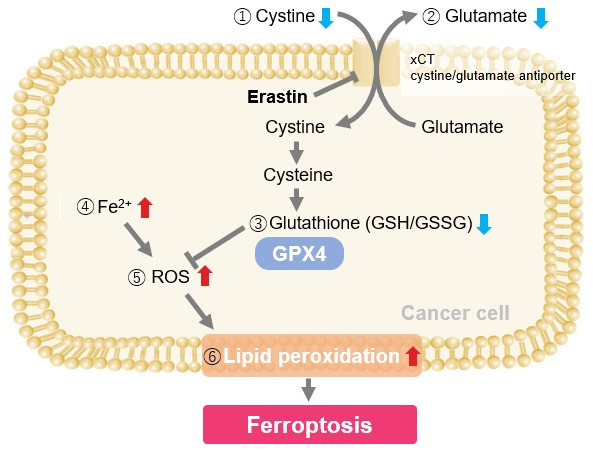

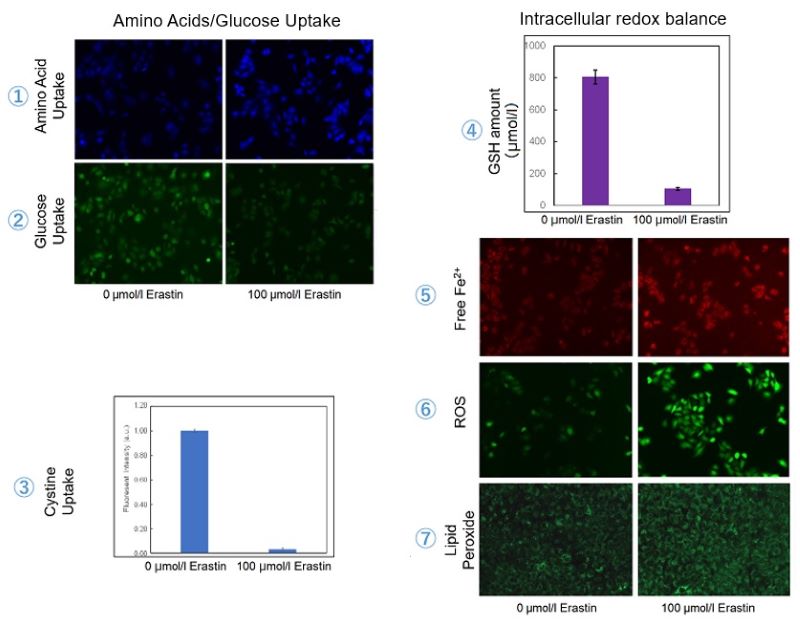
| 1 Amino Acid Uptake | : Amino Acid Uptake Assay Kit (Code: UP04) |
| 2 Glucose Uptake | : Glucose Uptake Assay Kit-Green (Code: UP02) |
| 3 Cystine Uptake | : Cystine Uptake Assay Kit (Code: UP05) |
| 4 Intracellular glutathione | : GSSG/GSH Quantification Kit (Code: G257) |
| 5 Intracellular labile Fe | : FerroOrange (Code: F374) |
| 6 Intracellular total ROS | : ROS Assay Kit -Highly Sensitive DCFH-DA- (Code: R252) |
| 7 Lipid Peroxides | : Liperfluo (Code: L248) |
Cell Line: A549
Incubation Conditions: 100 μmol/l Erastin/MEM, 37℃, 3h